A synthetic tetrapeptide discussed in cellular, animal and computational research.
In simple words
Epitalon is a short chain of four amino acids, commonly written Ala-Glu-Asp-Gly. Researchers study its interactions with biological systems; the name does not establish anti-ageing effects in people.
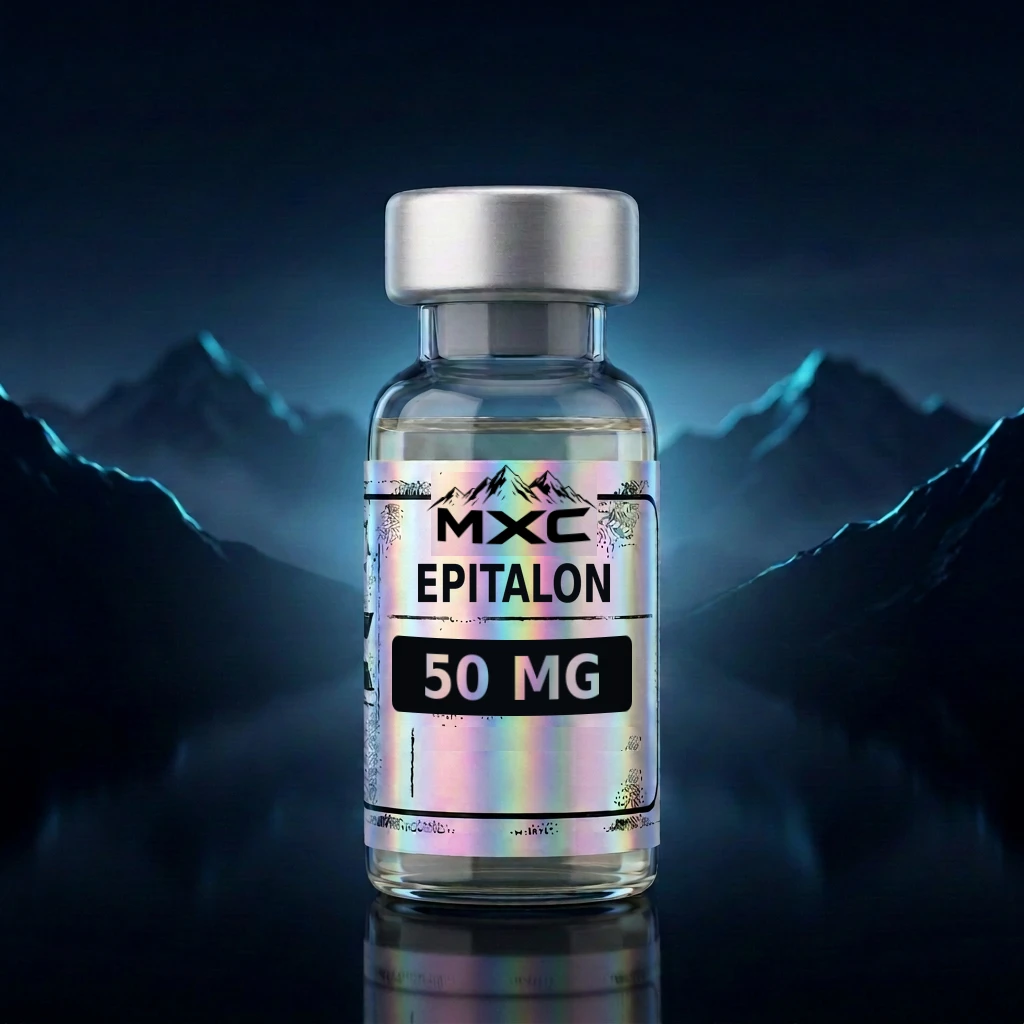
The named research compound is described here; the identity and formulation of this catalogue vial have not been independently verified. Epitalon is distinct from the pineal extract Epithalamin.
Literature review — cellular, animal and computational research
A review of multiple experimental models, not a single randomized human trial or a single participant sample.
The review identifies Epitalon as Ala-Glu-Asp-Gly and surveys studies of cellular signalling and biochemical activity.
A literature review does not establish benefits or safety of this vial. The authors note remaining uncertainty about mechanisms and limited physicochemical and structural investigations.
PMID 40141333. Indexed abstract checked through Europe PMC on 2026-11-10. Selected evidence, not a systematic review performed by MXC.
Resources
Identity search; no unambiguous compound record assigned to this listing. Check forms and synonyms carefully.
Evidence on studied compounds does not establish the identity, purity, safety, or regulatory approval of the catalogue vial. No Canadian regulatory status is assessed here.
Research questions about Epitalon
What is Epitalon?
Epitalon is a short chain of four amino acids, commonly written Ala-Glu-Asp-Gly. Researchers study its interactions with biological systems; the name does not establish anti-ageing effects in people.
What types of research are cited for Epitalon?
The Epitalon profile contains the following selected evidence. This is not a systematic review or a complete inventory of research.
Overview of Epitalon—Highly Bioactive Pineal Tetrapeptide with Promising Properties (2025): Literature review — cellular, animal and computational research
Overview of Epitalon—Highly Bioactive Pineal Tetrapeptide with Promising Properties (2025): A review of multiple experimental models, not a single randomized human trial or a single participant sample.
The named research compound is described here; the identity and formulation of this catalogue vial have not been independently verified. Epitalon is distinct from the pineal extract Epithalamin.
What do the selected Epitalon studies not establish?
Overview of Epitalon—Highly Bioactive Pineal Tetrapeptide with Promising Properties (2025): A literature review does not establish benefits or safety of this vial. The authors note remaining uncertainty about mechanisms and limited physicochemical and structural investigations.
These studies do not establish the identity, purity, safety or effects of the MXC Epitalon vial. Findings in one formulation, population or experimental model should not be assumed to apply to another.